

The Basics of Wheel Fitment:
Offset:
- Wheel offset is the distance from the wheel’s centerline to the hub mounting surface on the back of the wheel face. This measurement is given in millimeters.
- Offset has a big impact on how a wheel looks. UTV wheels with low or negative offset usually have a more concave surface and can create a deep lip, depending on the wheel’s design. Offset affects both how the wheel fits and its overall style.
Backspacing:
- Backspacing measures the distance from the hub mounting surface to the back edge of the wheel, rather than from the centerline.
- Backspacing is less precise because it uses inches, while offset is more exact and uses millimeters.
Correct offset and backspacing allow enough room for the suspension, brake, tires, and steering systems to operate without interference from the wheel. The numbers below show how your UTV wheels will fit on your vehicle’s hub. Depending on the offset or backspacing you choose, your wheels might stick out past the original width, stay the same, or sit under the fender. This change happens only through offset and backspacing, with no need to modify your suspension or vehicle.
Why is this important?
If you’re like most new UTV owners, you probably want to keep your suspension and vehicle width close to the original. Manufacturers spend a lot of time and money designing the right setup. Knowing your UTV’s original offset helps you pick aftermarket wheels that fit as closely as possible.
Some of you may have bought a 64" wide base but want more overall width. In this case, you'd benefit from a low-offset wheel to push the wheels out, thereby improving your overall width without incurring additional costs (other than the cost of new wheels).
Example: Polaris RZR Pro R

The Polaris RZR Pro R comes from the factory at 74 inches wide. Changing the offset can adjust your vehicle’s width by several inches. If you need to fit a wide machine like the Pro R into a trailer, every inch counts.

Polaris RZR Pro R features a 15x7 +62mm offset OEM wheel, which translates to a 6.44" backspacing. You will often hear people refer to this as a 6+1 setup, meaning 6" backspacing and 1" lip, resulting in a 7" total wheel width.
Stock 2024 RZR Pro R wheels: 15x7 61.85mm (or 6.44)
| EXAMPLE 1 | OFFSET | BACKSPACE |
| RZR Turbo R | +62mm | 6.44" |
| V09 UTV wheel | +40mm | 5.57" |
| DIFFERENCE | +22mm | 0.87" |
| EXAMPLE 2 | OFFSET | BACKSPACE |
| RZR Turbo S | +55mm | 6.17" |
| V03 UTV wheel | +25mm | 4.98" |
| DIFFERENCE | +30mm | 1.19" |
Examining the Polaris RZR Turbo R and RZR Turbo S offsets and backspacing examples above, the Valor Offroad V09 UTV wheel would be considered a 5+2, and the Valor Offroad V03 UTV wheel would also be considered a 5+2, despite a 30mm difference between the two. You can quickly see why general backspacing isn't as specific as offset, since most people treat 4.98+2.02 as a 5+2, and 5.57+1.43 is often represented as a 5+2. Valor Offroad will always use the offset measurement to give the end user an exact fitment measurement.
Now, let’s look at some clear examples to show how backspacing can really change how your wheels and tires fit.

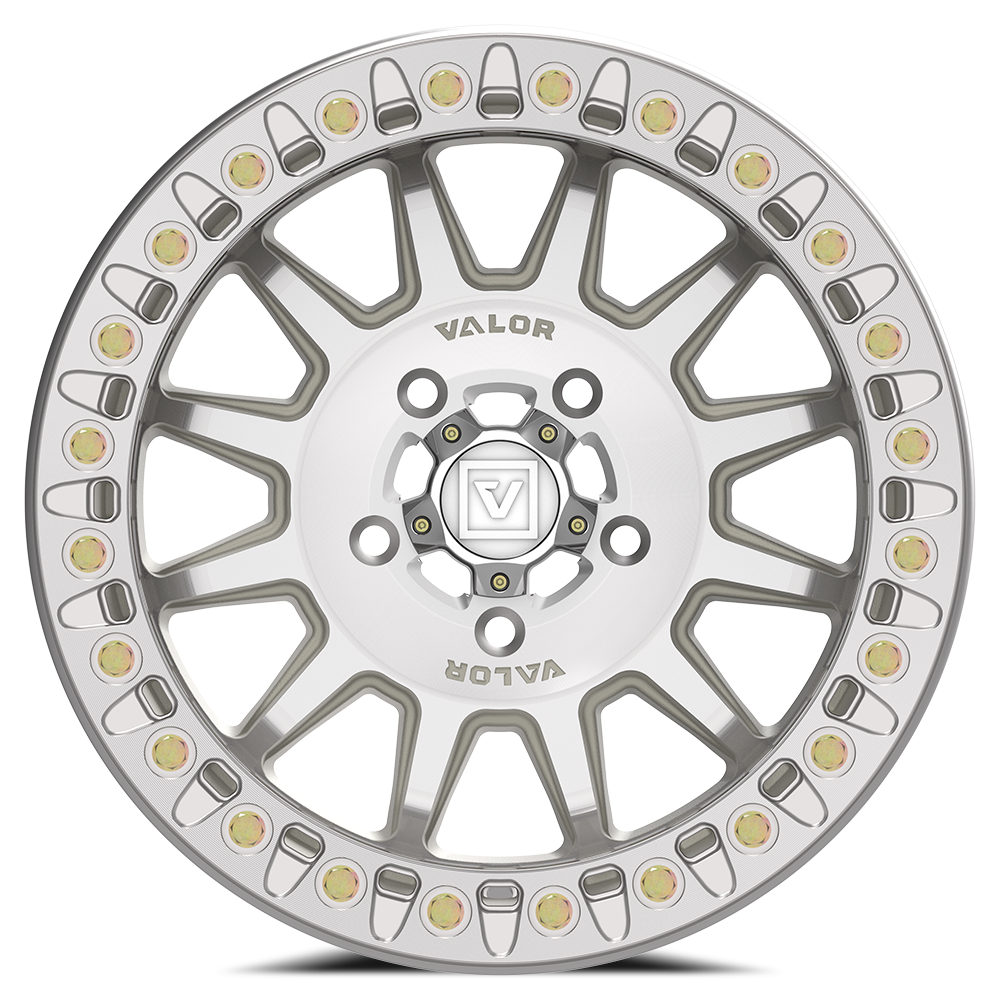
A negative offset, like -47mm, gives wheels deep spokes that curve back from the edge, creating a deep dish look. This style is common on sand machines that need better traction. On the other hand, a +50mm offset is close to the factory spec and has spokes that are almost flat with the edge. Factory UTV wheels often look plain because their high offset leaves little room for lip or spoke depth.

Check out our varying offsets:
Backspacing measures the space behind the wheel’s mounting pad. That’s why high-offset UTV wheels have high backspacing (like 6+1), and deep dish negative offsets have low backspacing (like 1+6). The first number is the space behind the mounting area, and the second is the space in front (where the spokes are). For example, a 7-inch wide wheel with 3.5 inches of backspacing has zero offset (+0mm) because the mounting surface lines up with the wheel’s center.
You don’t have to keep everything stock or match the OEM specs if you don’t want to.
7" WIDE SPECS
|
OFFSET |
WIDTH GAIN |
| 6+1 / +55mm | 0.0-1.5" wider per side over stock |
| 5+2 / +35mm | 1.0-1.5" wider per side over stock |
| 4+3 / +15mm | 1.5-2.0" wider per side over stock |
| 3.5+3.5 / +0mm | 1.5-2.5" wider per side over stock |
| 4+4 / -12mm | 3.0" wider per side over stock |
| 2+5 / -47mm | 4"+ wider per side over stock |
8" WIDE SPECS
|
OFFSET |
WIDTH GAIN |
| 6+2 / +40mm | 1.0-1.5" wider per side over stock |
Valor Offroad UTV Wheel Backspacing Conversion Chart
| STYLE | OFFSET | BACKSPACE |
| V01 15x7 | +15mm | 4.59 (4+3) |
| V02 15x7 | +20mm | 4.79 (4+3) |
| V03 15x7 | +25mm | 4.98 (5+2) |
| V03 15x10 | +0mm | 5.50 (5+5) |
| V03 14x7 | -32mm | 2.74 (2+5) |
| V04 15x7 | +15mm | 4.59 (4+3) |
| V05 15x7 | +35mm | 5.38 (5+2) |
| V06 15x8 | +40mm | 6.07 (6+2) |
| V06 15x10 | +25mm | 4.52 (4+6) |
| V07 15x7 | +25mm | 4.98 (5+2) |
| V08 15x7 | +30mm | 5.18 (5+2) |
| V09 15x7 | +40mm | 5.57 (5+2) |
| V09 17x8 | +40mm | 6.07 (6+2) |
| V13 15x7 | +10mm | 4.39 (4+3) |
| V14 14x7 | +20mm | 4.79 (4+3) |
| V14 15x7 | +20mm | 4.79 (4+3) |
| V15 15x7 | +45mm | 5.77 (5+2) |
| V16 15x7 | +35mm | 5.38 (5+2) |
| V16 15x8 | -12mm | 4.03 (4+4) |
Why are there two ways to measure the same thing?
Many new UTV and ATV owners get confused about offset and backspacing. Since both give you similar information, why do we use both? In the automotive world, offset is the standard, while the powersports industry uses backspacing. If you’re used to cars, you're probably most familiar with offset, which is why both terms are common.