



The difference between offset and backspacing is one of the most misunderstood topics in the industry. Walk into almost any dealership, browse aftermarket wheel listings, or ask a group of riders which measurement is more important, and you'll likely hear backspacing referenced far more often than offset. But why?
The irony? Offset is the measurement virtually every OEM engineer, automotive manufacturer, and wheel manufacturer uses when creating a wheel. Backspacing is largely a legacy measurement that remains popular because it's easy to understand using nothing more than a straightedge and a tape measure.
While both measurements describe where a wheel sits relative to the hub, one is clearly more precise. Understanding why requires looking at where these measurements came from, how they're calculated, and why offset has become the worldwide engineering standard.

Offset vs. Backspacing: What's the Difference?
Although they're often used interchangeably, offset and backspacing measure two completely different things.
Wheel Offset measures the location of the wheel mounting pad relative to the wheel's true centerline.
Backspacing measures the physical distance from the wheel mounting pad to the inside edge (back lip) of the wheel.
Both describe wheel position—but from completely different reference points. Think of offset as measuring from the wheel's center. Think of backspacing as measuring from one edge of the wheel. That difference matters far more than most riders realize.
What is Wheel Offset?
Offset is the distance between the wheel's mounting surface and its exact centerline, always expressed in millimeters. Offset has a big impact on how a wheel looks. UTV wheels with low or negative offset usually have a more concave surface and can create a deep lip, depending on the wheel’s design. Offset affects both how the wheel fits and its overall style.
Offset can be:
- Positive (+)
- Zero (0)
- Negative (-)

Positive Offset
A positive offset means the mounting surface is in front of the centerline, toward the outside (visible) face of the wheel. The "face" of a wheel refers to the spokes, cap, and generally anything visually perpendicular to the tire. Positive offset can span a large range, from +1mm to +65mm+.
The higher the positive number:
- The farther the tire sits inward
- The narrower the vehicle's overall width becomes
- The less the wheel protrudes from the vehicle (more OEM)
Zero Offset
The hub mounting surface sits directly on the wheel's centerline, meaning the wheel is perfectly balanced inward and outward. Keep in mind, this does not mean positive- or negative-offset wheels are not "balanced"; it just means that both the mounting pad and the wheel's "face" sit closer to the middle of the width.
Negative Offset
Negative offset moves the mounting pad toward the inside of the wheel, toward the brakes/axle. Many aftermarket UTV wheels intentionally use lower or negative offsets to create a wider stance, improving stability and performance.
The result:
- Wheels stick farther outward
- Wider stance
- Increased leverage on bearings and suspension components
Valor Offroad has a variety of wheel offset options:
So...What is Backspacing?
Backspacing is the distance from the mounting pad to the back edge of the wheel, measured in inches rather than millimeters.
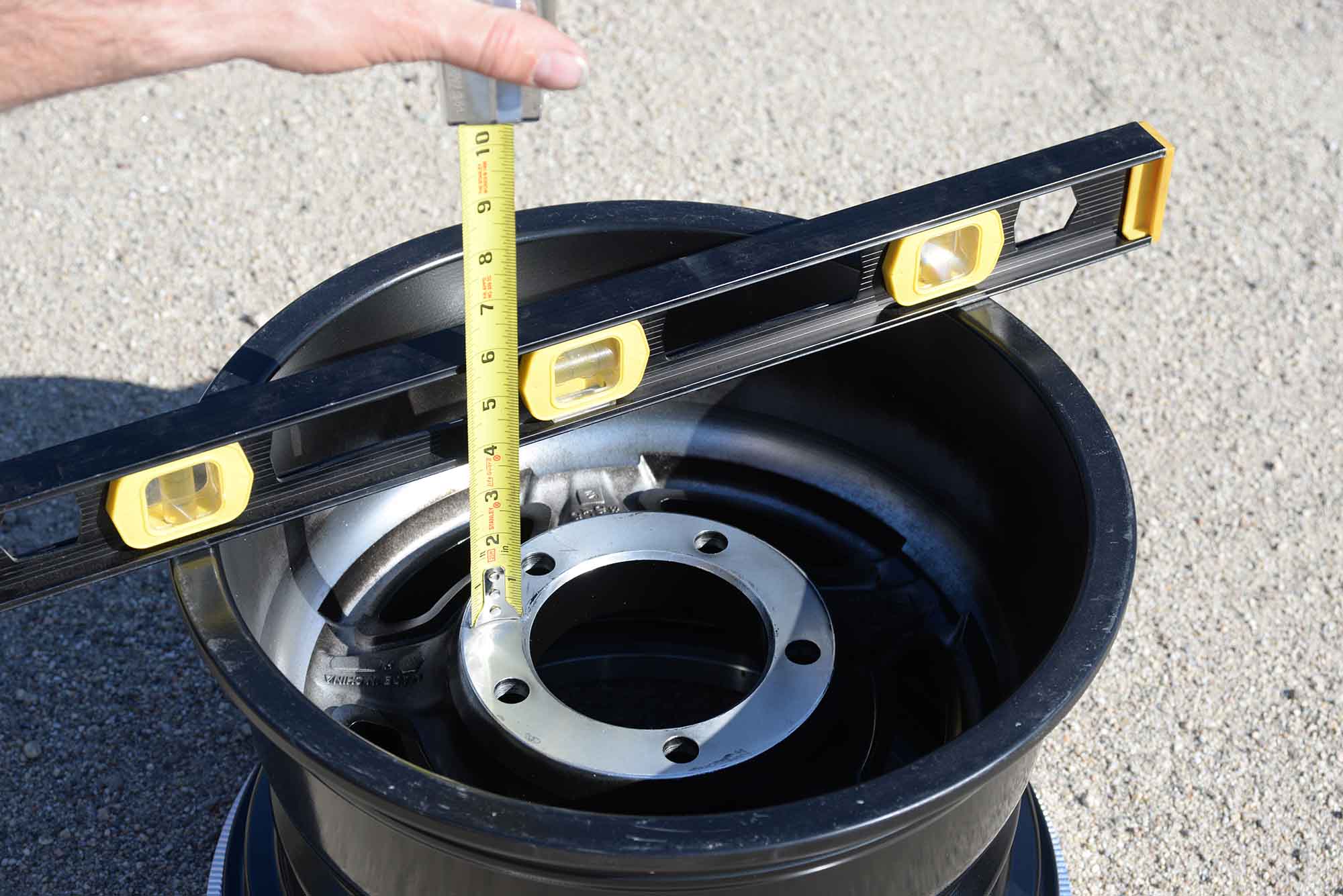
To measure it (see top blog post image):
- Lay the wheel face down.
- Place a straight edge across the rear lip.
- Measure down to the mounting surface.
Pretty Simple. No math required, which is why backspacing became so popular decades ago and still remains the go-to measurement/reference.
Where Did Backspacing Come From?
Backspacing originated in the American hot rod and off-road scene during the 1950s through the 1980s. At the time, wheel widths varied dramatically from front to rear, requiring a reference point to determine suspension clearance, as many wheels during this period were custom-built
Before digital CAD systems existed, builders simply measured from the wheel lip inward. No calculations. No centerlines. No engineering drawings. Just a tape measure. For custom fabrication, that worked perfectly. As a result, American wheel companies adopted backspacing as their primary measurement, and, fortunately/unfortunately, the terminology stuck.
Even today, many truck and off-road wheel manufacturers still advertise backspacing first because that's what many enthusiasts grew up using.
Where Did Offset Come From?
Offset comes from automotive engineering.
European manufacturers—including Mercedes-Benz, BMW, Audi, Volkswagen, and countless others—needed a standardized way to define wheel geometry across thousands of different wheel widths and vehicle platforms.
Rather than referencing the wheel edge, engineers referenced the wheel's centerline. That decision solved a major problem because the centerline never changes conceptually; the wheel edge does.
As CAD software became standard throughout the automotive industry, offset became the universal engineering measurement. Today, virtually every major automotive manufacturer designs wheels around offset. Internally, engineers work with offset because it integrates directly into suspension geometry, steering design, brake packaging, and wheel bearing load calculations.
Why Offset Is More Precise
Here's where the two measurements begin to separate. Backspacing depends on wheel width. Offset does not.
Consider these two wheels:
Wheel A
- 7-inch width
- +38 mm offset
Wheel B
- 8-inch width
- +38 mm offset
The offset is identical. The mounting surface occupies the exact same position relative to the wheel centerline. The suspension geometry remains consistent. However, the backspacing changes because the wheel itself became wider.
Nothing about the hub location changed. Only the wheel edges moved. This illustrates the core limitation of backspacing. Backspacing refers to the distance from one edge of a specific wheel. Offset describes the actual location of the hub. That distinction makes offset far more useful for engineering and vehicle fitment.
Why Engineers Prefer Offset
Suspension engineers don't design around wheel lips.
They design around:
- Steering axis
- Scrub radius
- Kingpin inclination
- Brake clearance
- Wheel bearing loads
- Hub centerline
- Suspension travel
Every one of those measurements references the wheel center, not the edge. That's why offset appears on engineering drawings while backspacing rarely does.
Why Many Riders Still Prefer Backspacing
Despite its limitations, backspacing remains popular for good reasons. Backspacing is easy to measure, easy to visualize, requires no calculations, and is super useful when specifically checking suspension clearance
If someone asks, "Will this wheel hit my shock?", backspacing can quickly provide an answer. For garage measurements, it's incredibly practical. For engineering, not so much.
The Biggest Problem With Backspacing
Let's compare these wheels to show how backspacing can fail comparing two wheels:
- 7-inch wheel with 5 inches of backspacing
- 8-inch wheel with 5 inches of backspacing
Most riders assume they're equivalent; they're not. The offset is significantly different, the centerline moved, and the suspension geometry changed.
This is where confusion begins. Two wheels can have identical backspacing while having completely different offsets. Likewise, two wheels can have identical offsets but different backspacing. Without knowing wheel width, backspacing tells only part of the story, while offset tells the complete story.
Converting Offset to Backspacing
Because the two measurements are related, you can convert between them.
The basic relationship is:
Backspacing = (Wheel Width + Lip Thickness) ÷ 2 + Offset
The exact calculation accounts for the wheel's overall measured width, including the rim flanges, rather than just the advertised bead-seat width. That's why published conversion charts sometimes vary slightly.
Which Measurement Should You Use?
If you're checking for garage clearance (making sure your vehicle fits in your garage), backspacing is perfectly acceptable.
If you're comparing wheels, selecting aftermarket fitments, maintaining steering geometry, or need a more detailed vehicle width, offset is the superior measurement. It's more precise, more consistent, and independent of wheel width.
Why Valor Offroad Uses Offset
At Valor Offroad, we specify wheel fitment by offset because it's the most accurate, repeatable, and universally accepted way to define a wheel's position relative to the hub. Offset allows riders to compare wheels across different widths without introducing ambiguity, making it easier to choose the correct fitment whether you're upgrading tires, widening your stance, or preserving factory steering geometry.
Backspacing still has value when measuring physical clearance in the garage, but it's tied to wheel width and doesn't fully describe a wheel's position. Offset provides a single, standardized measurement that engineers, OEMs, and designers rely on throughout the development process—and that's why it's the foundation of our fitment recommendations.
Frequently Asked Questions
Is offset more accurate than backspacing?
Yes. Offset references the wheel's centerline, making it independent of wheel width and directly comparable across different wheel designs or bands. Backspacing changes whenever wheel width changes.
Why do wheels still advertise backspacing?
Backspacing has deep roots in the American off-road and hot rod industries, where builders often measured clearance with simple hand tools. Many manufacturers continue using it because customers are familiar with the terminology.
Does changing the offset affect the suspension?
Yes. Offset influences track width, scrub radius, steering feel, wheel bearing loads, and suspension leverage. Even relatively small changes can alter how a vehicle handles and create new points of wear and tear.
Can two wheels have the same backspacing but different offsets?
Absolutely. If the wheel widths differ, identical backspacing values can correspond to different offsets. That's one reason offset is the more complete specification.
Is backspacing obsolete?
No. Backspacing remains a useful measurement for checking physical clearance to suspension components, brake hardware, and chassis parts. It simply isn't as effective as offset for describing a wheel's true mounting position or comparing fitments across different wheel widths.
Example: Polaris RZR Pro R
Some of you may have bought a 64" wide base but want more overall width. In this case, you'd benefit from a low-offset wheel to push the wheels out, thereby improving your overall width without incurring additional costs (other than the cost of new wheels).

The Polaris RZR Pro R comes from the factory at 74 inches wide. Changing the offset can adjust your vehicle’s width by several inches. If you need to fit a wide machine like the Pro R into a trailer, every inch counts.

Polaris RZR Pro R features a 15x7 +62mm offset OEM wheel, which translates to a 6.44" backspacing. You will often hear people refer to this as a 6+1 setup, meaning 6" backspacing and 1" lip, resulting in a 7" total wheel width.
Stock RZR Pro R wheels: 15x7 61.85mm (or 6.44)
| EXAMPLE 1 | OFFSET | BACKSPACE |
| RZR Turbo R | +62mm | 6.44" |
| V09 UTV wheel | +40mm | 5.57" |
| DIFFERENCE | +22mm | 0.87" |
| EXAMPLE 2 | OFFSET | BACKSPACE |
| RZR Turbo S | +55mm | 6.17" |
| V03 UTV wheel | +25mm | 4.98" |
| DIFFERENCE | +30mm | 1.19" |
Examining the Polaris RZR Turbo R and RZR Turbo S offsets and backspacing examples above, the Valor Offroad V09 UTV wheel would be considered a 5+2, and the Valor Offroad V03 UTV wheel would also be considered a 5+2, despite a 30mm difference between the two. You can quickly see why general backspacing isn't as specific as offset, since most people treat 4.98+2.02 as 5+2 and 5.57+1.43 as 5+2. Valor Offroad will always use the offset measurement to provide the end user with an exact fitment.
Now, let’s look at some clear examples to show how backspacing can really change how your wheels and tires fit.
A negative offset, like -47mm, gives wheels deep spokes that curve back from the rim, creating a deep-dish look. This style is common on sand machines that need better traction. On the other hand, a +50mm offset is close to the factory spec and has spokes that are almost flat with the edge. Factory UTV wheels often look plain because their high offset leaves little room for lip or spoke depth.
Backspacing measures the space behind the wheel’s mounting pad. That’s why high-offset UTV wheels have high backspacing (like 6+1), and deep dish negative offsets have low backspacing (like 1+6). The first number is the space behind the mounting area, and the second is the space in front (where the spokes are). For example, a 7-inch-wide wheel with 3.5 inches of backspacing has a zero offset (+0mm) because the mounting surface lines up with the wheel’s center.
You don’t have to keep everything stock or match the OEM specs if you don’t want to.
7" WIDE VEHICLE WIDTH GAIN
|
OFFSET |
WIDTH GAIN |
| 6+1 / +55mm | 0.0-1.5" wider per side over stock |
| 5+2 / +35mm | 1.0-1.5" wider per side over stock |
| 4+3 / +15mm | 1.5-2.0" wider per side over stock |
| 3.5+3.5 / +0mm | 2.0-2.5" wider per side over stock |
| 2+5 / -47mm | 4"+ wider per side over stock |
8" WIDE VEHICLE WIDTH GAIN
|
OFFSET |
WIDTH GAIN |
| 6+2 / +40mm | 1.0-1.5" wider per side over stock |
| 5+3 / +10mm | 2.0-2.2" wider per side over stock |
| 4+4 / -12mm | 2.8-3.0" wider per side over stock |
Valor Offroad UTV Wheel Backspacing Conversion Chart
| STYLE | OFFSET | BACKSPACE |
| V01 15x7 | +15mm | 4.59 (4+3) |
| V02 15x7 | +20mm | 4.79 (4+3) |
| V03 15x7 | +25mm | 4.98 (5+2) |
| V03 15x10 | +0mm | 5.50 (5+5) |
| V03 14x7 | -32mm | 2.74 (2+5) |
| V04 15x7 | +15mm | 4.59 (4+3) |
| V05 15x7 | +35mm | 5.38 (5+2) |
| V06 15x8 | +40mm | 6.07 (6+2) |
| V06 15x10 | +25mm | 4.52 (4+6) |
| V07 15x7 | +25mm | 4.98 (5+2) |
| V08 15x7 | +30mm | 5.18 (5+2) |
| V09 15x7 | +40mm | 5.57 (5+2) |
| V09 17x8 | +40mm | 6.07 (6+2) |
| V13 15x7 | +10mm | 4.39 (4+3) |
| V14 14x7 | +20mm | 4.79 (4+3) |
| V14 15x7 | +20mm | 4.79 (4+3) |
| V15 15x7 | +45mm | 5.77 (5+2) |
| V16 15x7 | +35mm | 5.38 (5+2) |
| V16 15x8 | -12mm | 4.03 (4+4) |
| V17 15x8 | +10mm | 4.89 (5+3) |
| V18 15x7 | +30mm | 5.18 (5+2) |