

Best UTV Trailer or ATV Trailer
We put together a cheat sheet, including pros and cons, of all the available powersports trailers on the market today. There is a lot to choose from, so this post is here to help you along your journey and address (and avoid) potential buyer's remorse. We gathered feedback from our own experience, chatting with other owners around the campfire, and directly from the product sales teams.
This post will address the most common questions when searching for trailers:
- What type of UTV trailer do I need?
- What size UTV trailer do I need?
- How much do UTV trailers cost?
- What is the length of my UTV or ATV?
- What trailer accessories should I put in/on my UTV Trailer?
Types of UTV Trailers and ATV Trailers
Open Bed (Utility) Trailer
The most popular and one of the cheaper options is the open (or open-bed) trailer. The "open" part means that the vehicle or contents you plan to haul are exposed to the elements, parking lots, and eyeballs. This type of trailer typically has small side rails to keep contents from falling off during transit and provides a range of tie-down options depending on the manufacturer.

Trailer Pros:
- Price. Comparing this trailer style to some of the other options on this list, you'll quickly see why this is the most popular.
- Easy access. Need to grab something off of the trailer? Boom, super easy to access, add, remove,e or use.
- Load ramp. Because the back wall of the trailer is the load ramp, preparing your trailer for loading is a snap (remember to keep it mounted to your truck).
Trailer Cons:
- Theft. Even a stock UTV is prone to theft if left unattended in an insecure location. If you have to store your trailer at a public storage facility, make sure you don't leave anything in or on your machine before storing it. It might make sense to beef up your insurance to cover all upgraded aftermarket accessories in case someone decides to make what is yours theirs.
- Typically, the floor of an open bed trailer is made of a natural material like wood. This makes the unit cheaper; however, maintenance must play into your decision because the floor WILL need to be replaced eventually. You'll also want to make sure the trailer's load rating exceeds your loaded vehicle weight (gas, tools, cooler, etc.).
Flat Bed Trailer
The flatbed trailer is the beefier cousin of the open-bed trailer. The flatbed trailer has no side rails, and the only way to load your machine(s) is to manually assemble ramps on the back of the trailer. Typically, the flatbed trailer has a higher load rating than an open trailer and can accommodate three, four, even five+ UTVs on one trailer (as long as your truck can handle it).

Trailer Pros:
- Price. Not quite as cost-effective as the open bed trailer, the flat bed trailer is still cheaper than some other options.
- Tie Downs. You can find wood-slatted flatbed trailers, but the most common version is a full metal one (see pic above) with dozens of tie-down options for any vehicle arrangement.
Trailer Cons:
- Theft. Same as with the open-bed trailer, make sure you don't leave anything lying around on an exposed trailer setup like this. Even gas cans, helmets, goggles, or charge cables are prone to theft if left unattended for too long.
- Storage. Because the flat bed option does not have side rails or half walls, bungee cords or attaching anything to the trailer becomes difficult or even impossible.
Truck Racks
Want to haul your UTV right on top of your truck? The truck rack is your option. Not the most common way to move your UTV around, but a great solution if you have limited space and don't want to take on another insurance liability (a trailer). The rack bolts directly to your vehicle so you can quickly mount up and get on the road.

Trailer Pros:
- Cost. If you know how to wrench, this could be the cheapest option because you don't have storage fees, insurance, or a physical trailer to purchase.
- Loading. Depending on your driving experience, this could be an easy load or the most painful/scary day of your life.
Trailer Cons:
- UTV Length/Width. Did you upgrade to that long travel kit? Did you go for the 35" tire option? Make sure your machine will fit before you start down this path. Measure every potential hazard three times to be sure.
- Cost. Because you are literally driving your machine on top of your truck, installing the rack can require some steep hours and permanent modifications to your truck. Remember resale value before making this choice. Yes, you should always ensure the total weight of your vehicle (gassed up and loaded) does not exceed roof trailer capacity.
Adventure Trailer
For those of you who want the best of both worlds of camping and hauling, the adventure trailer is your solution. There are dozens of adventure trailer brands and models in a myriad of lengths, widths, and prices, so do your research. Quality matters when you're paying full price for a large-budget solution; make sure you look at welding quality, material durability, and overall clearance.

Trailer Pros:
- All in one. Want a basecamp and a trailer? This is a great way to live out of your trailer with ample storage and sleeping opportunities to keep you out of inclement weather.
- Accessibility. All the theft worries of an open bed trailer or flatbed trailer go out the window with this option, which has tons of lockable storage bays and bins for all your camping/riding gear. Some of the upper-end models have a full kitchen and plug-ins for all sorts of electronics if that is your thing.
Trailer Cons:
- Price. Again, do your research on this type of trailer because, although the adventure trailer might seem like an amazing Swiss Army Knife for most situations, you may be shocked by how much these things cost.
- Weight. In most cases, these trailers are the heaviest option, but the built-in amenities might be worth it for some.
Closed Trailer
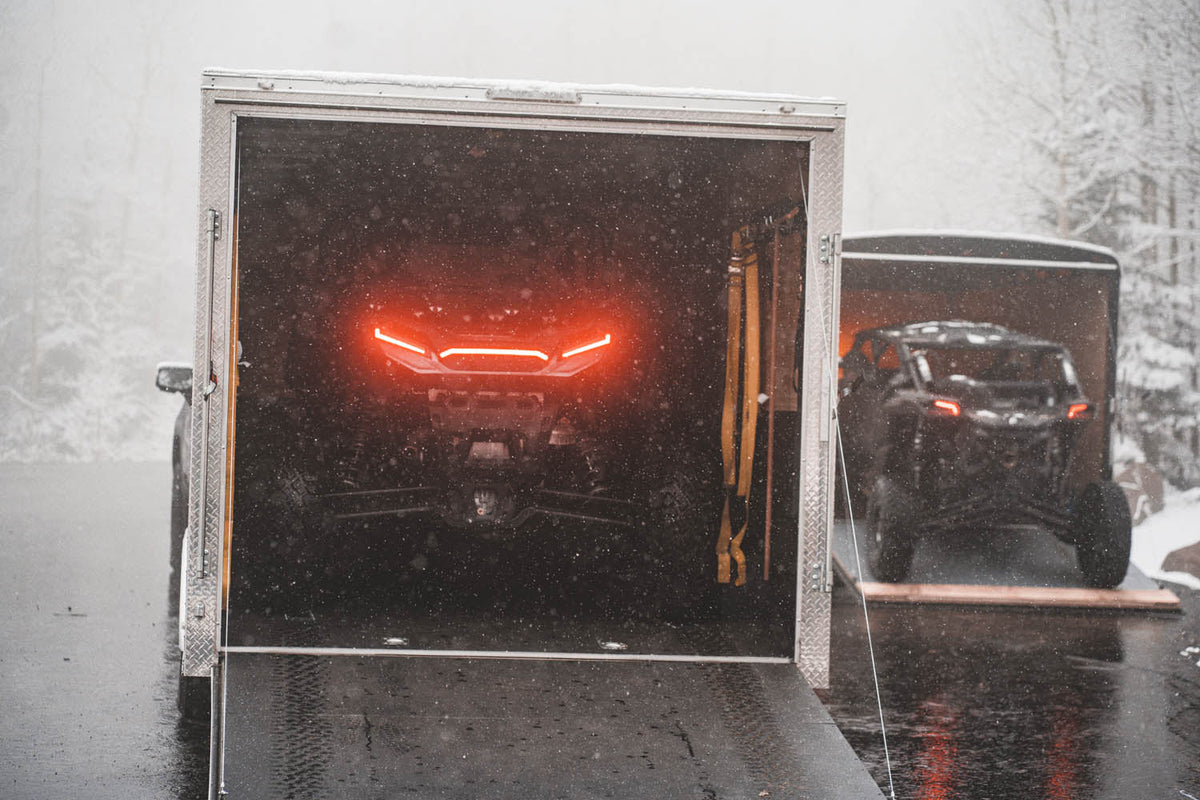
Storing your UTV or ATV in a public storage lot? Want to keep everything together so you don't clutter up your garage with gear? The closed trailer is a superb option for those with a larger budget who want to protect their investment from weather, sun damage, theft, and vandalism.

Trailer Pros:
- Security. Closed trailers can store your UTV, portable fire pit, shovels, gas cans, spare wheels/tires, generators, camp chairs, Pro Eagle jack, etc. If you live in a state with four seasons, this option might be your best bet because during the off-season (winter), you can lock this trailer up and walk away until the sun comes back. You spent a bunch of money buying your new machine; this solution will protect your investment.
Trailer Cons:
- Price. Although the closed trailer is a big upgrade with lots of pros, you'll want to keep an eye on options and accessories, which can push you into the $40-50K range for the full aluminum-framed version. On average, you'll pay around $10K for a covered trailer, nearly double the price compared to other options on this list.
- Accessibility. Need something quick while on the road? Forget about it. This trailer requires you to pop locks, open doors, and crawl around/over your machine to get what you need. Not a deal-breaker, just something to consider if you like to grab-and-go.
How Much Do UTV Trailers Cost?
- 18' Open Bed (Utility) Trailer: $6,500
- 20' Flat Bed Trailer: $8,500
- Truck Rack: $2,500
- 18' Adventure Trailer: $20,000
- 18' Closed Trailer: $14,000
The above costs are averaged across multiple vendors and spec levels. You should be able to find a used option for much less than the listed prices. Prices are based on an "average" build or trim model. Costs are based on 2026 inventory.
What size UTV Trailer Do I Need?
Picking the right trailer depends on a bunch of factors; first on that list is the size of the machine(s) you own. Owners of 2-seater UTVs will be looking at very different trailers than owners of 4-seater UTVs. Here are a couple of things to keep in mind when you're looking at or pricing out trailers.
- You'll want to balance your UTV or ATV in the center of the trailer. If it's too far forward or too far back on the trailer, you'll put unnecessary stress on moving parts that could increase your chances of failure.
- For our closed trailer fans, trust us, you'll want a few extra feet of space at the front, back, and sides of your machine to open/close doors and tie down easily. The last thing you want to do is have to contort into the fetal position every time you want to tie your machine down (from experience). That one-foot difference could mean the difference between fitting well and not fitting at all.
- Trailer GVWR. The gross vehicle weight rating (GVWR) is the maximum weight the trailer is rated to safely carry and transport, as specified by the manufacturer. The gross vehicle weight (GVW) is the combined weight of the trailer and its payload. Don't forget about your hauling vehicle! If your trailer weighs 3,000 lbs and your new UTV is pushing 2,000 lbs, your vehicle needs to be rated for at minimum 5,000 lbs. Most of the old-timers will tell you that, to tow comfortably, you should never exceed 70% of your vehicle's total towing capacity.
- UTV manufacturers' lengths vary per model and, in some cases, per year. We've listed a few overall lengths here for reference. All lengths are for 4-seat models unless noted.
- Polaris Sportsman XP 1000 = 6.9 feet
- Polaris RZR Turbo S 4 = 12.5 feet
- Polaris RZR XP 4 = 12.3 feet
- Polaris Ranger Crew = 12.7 feet
- Polaris Ranger Crew XD = 13.6 feet
- Polaris Xpedition = 12.7 feet
- Polaris General XP 4 = 12.5 feet
- Polaris RZR Pro R 4 = 13.8 feet
- Can-Am Maverick X3 Max RS = 13.7 feet
- Can-Am Defender Max = 13.2 feet
- Can-Am Maverick R X RS = 11.7 feet
- Can-Am Maverick Sport Max = 12.4 feet
- Can-Am Commander Max = 13.4 feet
- Can-Am Outlander Max = 7.8 feet
- Kawasaki Brute Force 750 = 7.2 feet
- Kawasaki Mule Pro = 11.1 feet
- Kawasaki KRX 4 = 13.1 feet
- Honda Rincon = 6.9 feet
- Honda Foreman = 6.9 feet
- Honda Recon = 6.2 feet
- Honda Pioneer 1000-5 = 9.7 feet
- Honda Talon XS-4 = 12.7 feet
Here are some quick stats to help you choose the right trailer for specific UTV models. We always recommend having at least a couple of extra feet (one foot on each end of the vehicle) to ensure easy loading and unloading, as well as easy tie-down. You can always cram a 13' machine onto a 14' trailer, but we're offering the below suggestions based on recommendations from dozens of sources and years of experience. Please keep in mind that these are based on 2026 specs; your exact length may vary if you have a model from before 2024. The "Trailer" below is the trailer length we recommend based on the specific vehicle size.
Keep in mind that wider models like the RZR Pro R and Maverick R are ridiculously wide, so you'll need a minimum of an 8.5' wide trailer in order to safely transport.
| VEHICLE | LENGTH | TRAILER |
| Ranger XD 1500 | 13.7 ft | 16 ft |
| RZR Pro R Boost | 11.3 ft | 14-16 ft |
| RZR XP 4 | 12.3 ft | 16 ft |
| RZR Pro R 4 | 13.8 ft | 16 ft |
| Defender Max | 13.4 ft | 16 ft |
| Maverick R X RS | 11.7 ft | 14-16 ft |
| Outlander Max | 7.8 ft | 10-12 ft |
| Maverick X3 Turbo RR 4 | 13.7 ft | 16-18 ft |
Recommended Trailer Accessories
We put together a list of our must-have trailer accessories in this post: Top 10 items you want in your trailer.