

UTVs continue to become faster, heavier, and more capable, placing greater demands on every component connecting the vehicle to the trail. Wheels must withstand hard impacts, changing terrain, larger tires, and increasingly powerful machines without adding unnecessary weight. Valor Offroad flow-formed UTV wheels address this challenge by combining a cast-aluminum foundation with an advanced forming process that strengthens and refines the wheel barrel.
1: The History of Flow Forming
Flow forming evolved from metal spinning, one of the oldest methods of shaping metal without cutting away material. Early metal-spinning techniques relied on manually operated lathes and skilled craftspeople, but advances in hydraulic machinery during the mid-20th century made it possible to form thicker, stronger materials with much greater accuracy.
The aerospace industry helped accelerate this development as manufacturers searched for lightweight, precisely formed components for turbine engines, rocket assemblies and other demanding applications. Automated machinery, computer-controlled rollers and more sophisticated process monitoring eventually transformed flow forming into a repeatable manufacturing method suitable for automotive components.
By the 1970s, CNC-controlled spinning machines made it possible to precisely manage roller pressure, speed and movement. Flow forming was gradually adopted by the automotive wheel industry as manufacturers recognized that it could produce a lighter, stronger barrel without requiring the expense of manufacturing an entire wheel from a forged aluminum billet.
Today, flow forming occupies an important position between traditional cast-wheel manufacturing and full forging. It offers many of the performance characteristics users want from a premium wheel while remaining significantly less expensive than a fully forged design.
2: The Flow-Forming Process
A flow-formed wheel begins with an aluminum "preform" produced through a casting process. Unlike a conventional cast wheel, the preform has a barrel that is intentionally shorter and thicker than its finished dimensions.

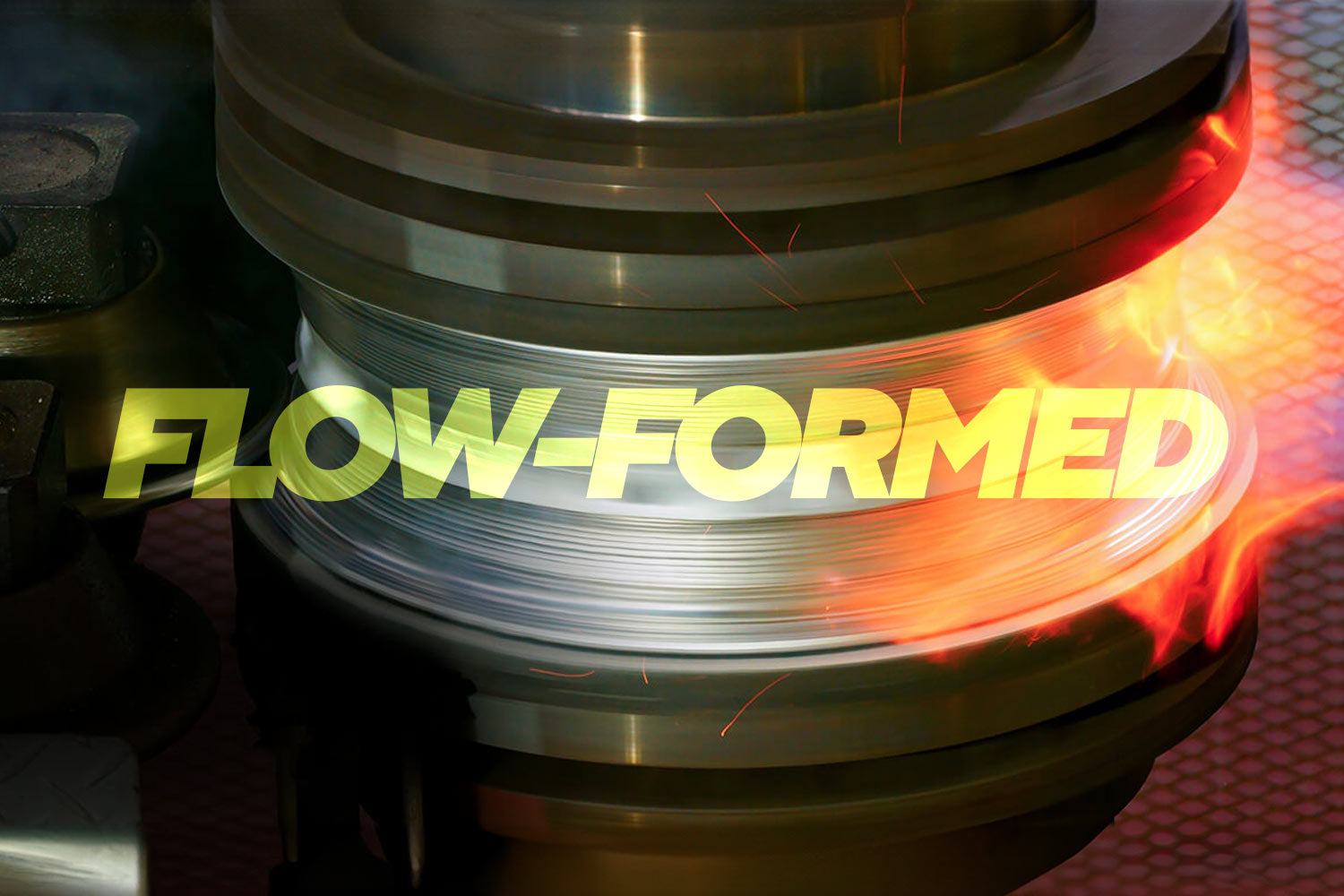
The preform is mounted over a precision mandrel inside a specialized flow-forming machine. As the wheel rotates at high speed, controlled heat is applied and one or more hydraulic rollers press against the outside of the barrel. These rollers travel across the rotating wheel, gradually compressing the aluminum and directing the material along the mandrel.
Rather than removing material, the process redistributes it. The thick barrel is stretched to its intended width while its wall thickness is reduced and carefully controlled. This mechanical working changes the aluminum’s microstructure in the formed area, creating a more refined and directionally aligned structure than would typically be found in an untouched cast barrel.

Recent SAE research on cast and flow-formed aluminum wheels found that flow forming allowed a substantial reduction in barrel thickness while improving elongation and producing modest increases in tensile strength. The finished wheel can therefore use material more efficiently instead of relying solely on additional aluminum to achieve the required performance.
3: The Advantages of Flow Forming for UTVs
Lower Wheel Weight
One of the most valuable benefits of flow forming is an improved strength-to-weight ratio. Because the barrel’s mechanical properties are enhanced during forming, engineers can reduce unnecessary material while still designing for demanding off-road use.
Wheel weight is both unsprung and rotating mass. Reducing it can help the suspension respond more effectively to rocks, ruts, washboard surfaces and rapid terrain changes. It also reduces the amount of rotating mass during acceleration and deceleration.
Vehicle make/model, vehicle trim, tire and/or wheel selection, and overall vehicle weight can skew benefits, but a lighter wheel package can contribute to more responsive handling, steering, and suspension behavior.
Greater Control on Rough Terrain
A UTV suspension works hardest when the tires are repeatedly moving over uneven ground. Heavy wheel-and-tire assemblies require more energy to change direction as the suspension cycles.
Reducing wheel weight can make it easier for the suspension to keep the tires in contact with the terrain. On fast terrain, this may help the vehicle feel more composed through chop and repeated bumps. In technical terrain, it can support more predictable wheel movement as the suspension articulates over rocks, ledges and uneven obstacles.
A Stronger, More Efficient Barrel
The barrel is exposed to significant stress from tire pressure, cornering loads and direct impacts. Flow forming mechanically works this critical area, improving its material properties and allowing its thickness to be more precisely controlled.
This does not make a wheel indestructible, but it allows the structure to be engineered more efficiently than a comparable barrel that remains entirely as-cast. For UTV owners running larger tires, traveling at higher speeds or carrying additional vehicle weight, that balance of strength and reduced mass is especially valuable.
Performance Across Different Terrain
Flow-formed UTV wheels are well suited to the varied conditions modern side-by-sides encounter:
-
On fast desert and hard-pack trails, lower rotating mass can support responsive acceleration, braking, and directional changes.
-
In rocks and technical terrain, an efficiently engineered barrel helps balance impact resistance with manageable weight.
-
In dunes, reducing rotating mass can help limit the additional load created by large paddle tires.
-
On recreational and utility vehicles, lighter wheels can reduce unnecessary mass while maintaining the strength required for everyday work and exploration.

- 1: The wheel face, including the center spokes and outer lip, is made using low-pressure die-casting. The rear barrel is not cast at this stage but will be formed later during the heated rotary forging process.
- 2: The rear barrel of the wheel is heated, and hydraulic rollers apply pressure to spread the aluminum. With even pressure, the barrel is shaped using a precise program and a rotating drum die.
- 3: The hydraulic rollers keep applying pressure until the barrel reaches its final width. At the end, the rear lip of the barrel is formed.
Flow forming offers many benefits. It improves the strength of aluminum and uses the material more efficiently. Compared to standard UTV wheel casting, flow-formed wheels are more precise, have a better surface finish, are harder, and have a better grain structure. This process makes UTV wheels both higher quality and more efficiently produced.

Grain Structure Matters
CNC machining is typically performed on a pre-worked (hardened) billet that already has grain flow. We use this process in our billet beadlock rings.
Cast UTV wheels do not have uniform grain structure, flow, or directional strength. During casting, slurry is poured into a mold, and as it cools, dendrites form and eventually solidify into grains. These grains are not uniform, as some may be small, large, coarse, and/or fine, which results in grain boundary voids. When there are voids in a manufactured component, it will have very little impact or fatigue resistance.
Flow forming aligns the grains in the aluminum to maximize strength, giving the wheels excellent resistance to fatigue and impact. By stretching the grain structure lengthwise, this process makes the aluminum much stronger. The direction of grain flow affects how the material handles stress and fatigue.